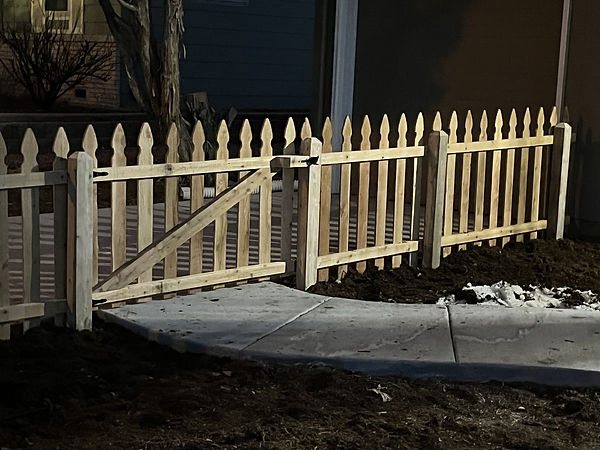
Picket Fences

Picket fences are popular because they look nice and are very useful. They can provide privacy, animal control, decoration, and a level of security. The most common style is six feet high with a simple line of pickets with the top corners cut, called "dog-ear", but there are many options. From different tops, different heights such as 3, 4, and 5 feet high, spaces between pickets for wind, the possibilities are endless. Pickets can be right and tight to each other (usually with small gaps because wood is natural, has variation, and shrinks), narrow gaps, wider spaces such that every other picket is missing, and even "shadow box", in which pickets are attached to both sides of the fence, but with every other picket missing and the gaps on one side lining up with the picket on the other, such that the pickets are alternating sides. Usually a gate is custom-built out of the same materials as the fence so that everything matches, but other options are also available.
These fences are constructed of a series of posts in the ground, with 2x4 rails attached, often 3 per section but 2 can be used for shorter fences, and pickets attached to the rails. There are various options for each of these parts of the fence. Which side has the pickets and which side shows the rails can be determined by various factors such as community standards, preference, and access.
Cedar is the standard material for picket fences, and staining and sealing the fence helps protect and preserve the wood. Pre-stained pickets are available, and are usually lower cost, but only one color is available and size is available. Cedar pickets typically come in two widths, the narrower about 3.5 or 4 inches wide and the wider about 5.5 or 6 inches wide, both 6 feet high. Shorter pickets are usually the narrow size.
The rails are usually cedar or brown pressure-treated lumber. The cedar takes stain well, but costs more. The pressure-treated is usually lower cost and resists rotting so lasts longer, but is prone to warping and distortion.
Posts can be cedar, pressure-treated, or metal. Metal lasts the longest but costs the most. Cedar looks nice and takes stain well, but doesn't last as long due to rotting under-ground. Pressure treated tends to cost less and lasts longer, but is prone to warping, twisting, and distorting.
Different materials can be selected for different parts of the fence. Some people choose all cedar. Others choose metal posts, pressure treated rails, and cedar pickets. Contact us to discuss options!